



#مرحبا بك في يمكنه المشاركة

لافتة
  • Can I use a controller in DCS?
    Can I use a controller in DCS? Jul 10, 2026
    Introduction Distributed Control System (DCS) is the core automation architecture for process industries including chemical, power, oil & gas, metallurgy, and municipal water treatment, focusing on centralized management and decentralized field control. Many automation engineers raise a typical question: Can independent controllers be deployed and used within a standard DCS system? This article clarifies application scenarios, connection methods, advantages, limitations and practical deployment suggestions for standalone controllers in DCS. 1. Core Definition: DCS Built‑in Controllers vs. External Independent Controllers A complete native DCS is equipped with dedicated redundant main controllers as the core control unit, responsible for closed‑loop regulation, interlock logic, sequence control and signal processing of field instruments and valves.   The “controller” mentioned in the question refers to third‑party standalone PLC/loop controllers/micro controllers outside the original DCS cabinet. Two usage modes exist:   1.1 Controller as a DCS Field Remote Control Unit   The standalone controller undertakes local on‑site control, transmits operating data, alarm signals and status points to the DCS upper monitoring system via communication protocols (Modbus RTU/TCP, Profibus DP, HART, Ethernet/IP). The DCS only realizes monitoring, parameter setting and remote emergency intervention, while the controller completes autonomous local control.   1.2 Controller Hot‑standby or Auxiliary Logic Supplement for DCS   When the original DCS controller has insufficient logic capacity, outdated hardware or high transformation cost, an external controller is used to bear partial complex interlock, batch control or safety auxiliary loop, interconnected with the main DCS via hard wiring or industrial Ethernet. 2. Typical Scenarios Where External Controllers Are Used in DCS Scenario 1: Local Independent Control for Remote Skid‑Mounted Equipment Package equipment such as boiler burners, compressors, refrigeration units, dosing skids are usually delivered with proprietary PLC controllers. It is impossible to redevelop logic into the main DCS for each skid. The controller runs the complete skid control program independently, and the DCS only reads key process data, fault alarms and start/stop commands, which is the most common application. Scenario 2: Old DCS Capacity Expansion with Low Investment For aging DCS systems that have reached IO point upper limits and discontinued main controller models, adding a small PLC controller for new process loops avoids the high cost of replacing the entire DCS mainframe. Only signal docking is required to complete system expansion. Scenario 3: Safety Isolation for High‑Risk Interlock Loops Critical safety interlocks (overpressure protection, fire isolation, emergency shutdown) are deployed on a separate safety controller (SIL‑rated PLC). Physical isolation is formed with the conventional DCS to prevent DCS main system faults, program crashes or misoperations from triggering safety accidents, meeting functional safety specification requirements. Scenario 4: Mobile/Temporary Process Control Temporary test devices, mobile sampling systems, temporary pipeline regulation loops use portable controllers, which can be quickly connected to the DCS monitoring network for temporary data collection, and removed after the test ends without modifying the core DCS configuration. 3. Connection Modes Between External Controllers and DCS Hardwire Signal Connection (4–20mA analog / DI/DO switch signal)   Stable transmission, strong anti‑interference, suitable for critical interlock signals; high wiring workload for multi‑point data transmission. Industrial Bus Communication Connection   High data density, less wiring, mainstream protocols: Modbus TCP/RTU, Profibus DP, Modbus TCP is the most widely used for cross‑brand DCS and controller interconnection. OPC UA/DA Upper Computer Docking   The controller uploads data to the DCS configuration station through OPC server, applicable to large‑volume data interaction, used for upper monitoring rather than fast interlock control. 4. Advantages of Adding Controllers to DCS Decoupling equipment supplier responsibility: Skid manufacturers are responsible for the controller program, avoiding disputes caused by DCS side program modification during equipment debugging and maintenance. Reduced DCS transformation cost and construction cycle for renovation projects. Local autonomous operation: When DCS host communication fails, the standalone controller maintains stable operation of on‑site equipment to avoid full‑process shutdown. Flexible configuration: Dedicated controllers are more convenient for customized batch control, motion control and special algorithm regulation compared with general DCS controllers. 5. Key Disadvantages & Risk Points to Avoid System fragmentation: Multiple brand controllers increase spare parts types and daily maintenance difficulty; unified asset management cannot be realized. Communication delay risk: Bus communication delay may cause failure of fast safety interlock, so critical interlock must adopt hardwire signal transmission. Clock synchronization deviation: Inconsistent system time between DCS and external controllers leads to disordered historical alarm records, requiring unified GPS clock synchronization. Program management loopholes: Independent controller programs are easy to be modified on site without DCS system change management, leading to hidden operation risks. 6. Engineering Best Practices Divide control levels clearly: DCS = centralized monitoring, set value adjustment, historical data recording; external controller = local closed‑loop control, equipment logic, safety interlock. Clarify the division of labor in the design document. Critical safety signals use hardwire connection only; ordinary process parameters adopt bus communication to balance safety and cost. Implement program version management for all external controllers, archive source programs uniformly in the DCS room, and prohibit arbitrary offline program modification. Complete system clock synchronization for all connected controllers and DCS hosts. Prioritize using the same brand of DCS supporting controllers if budget permits, to maximize system integration. Conclusion You can definitely use external controllers in a DCS system, and it is a mature and widely adopted engineering scheme in process automation. It is not a substitute for the core DCS main controller, but a powerful supplementary means for skid equipment docking, old system reconstruction, safety isolation and temporary control. As long as the control division, signal docking mode and program management are standardized, the hybrid architecture of DCS + decentralized controllers can balance operational stability, project cost and equipment independence perfectly. Would you need a shortened version for social media sharing or a pure English original blog without Chinese explanation?
  • What Is the Difference Between PLC and DCS Controllers? A Complete Guide
    What Is the Difference Between PLC and DCS Controllers? A Complete Guide Jul 10, 2026
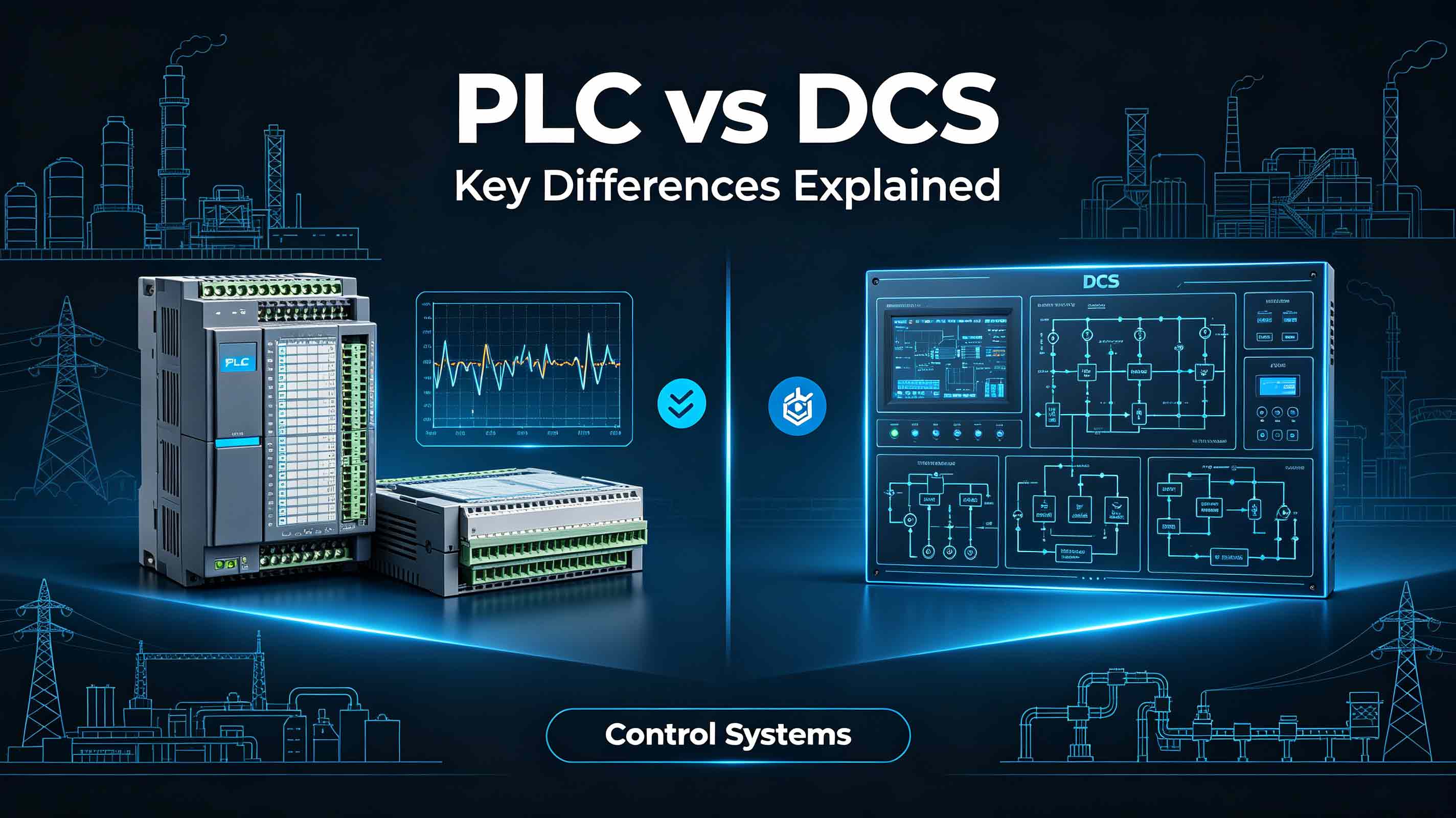
      In industrial automation, PLC and DCS are the two most widely used control systems. Both can monitor equipment, execute control logic, and keep production running stably. However, most engineers and procurement personnel often struggle to tell them apart: when should you choose a PLC, and when is a DCS more suitable? Although modern PLC and DCS functions overlap increasingly, their core design philosophy, system architecture, and applicable scenarios are fundamentally different. This article will break down their differences in plain language, covering working principles, application scenarios, performance characteristics, and cost, to help you make accurate project selections. 1. Core Definition & Original Design Purpose The essential gap between PLC and DCS stems from their original design positioning, which determines their inherent strengths and weaknesses. PLC (Programmable Logic Controller) PLC was developed in the late 1960s to replace cumbersome, unreliable relay-logic control panels. Its original core positioning is discrete on/off logic control, which handles equipment start/stop, safety interlocks, sequential operation, and high-speed boolean judgment for field switching signals. It is inherently designed for standalone equipment and skid-level control, prioritizing fast scan speeds and reliable discrete signal processing. While modern PLCs integrate high-precision PID analog regulation and complex algorithm functions, their fundamental architectural advantage remains high-speed discrete logic execution and flexible on-site programming, rather than large-scale coordinated process control. DCS (Distributed Control System) DCS (Distributed Control System) is a specialized control system built for large-scale, continuous, and thermally integrated process industries. Its core design principle is strictly industry-standard: distributed decentralized control, centralized unified supervision. It distributes independent control functions to decentralized field control stations, avoiding centralized single-point concentration of control tasks. The upper monitoring layer realizes unified data collection, real-time monitoring, parameter tuning, production scheduling and fault management. DCS is optimized for long-term stable closed-loop control of analog process variables, including temperature, pressure, flow rate, liquid level, and composition parameters in continuous production. 2. Key Structural & Working Principle Differences The architectural differences directly lead to their distinct performance and expansion capabilities. PLC: Centralized Control Architecture Standard PLCs adopt a centralized control architecture: one or multiple CPU main controllers undertake all logic operation, program scanning, and data processing tasks. Field I/O modules are directly mapped to the main controller, featuring simple topology, fast response, and convenient debugging. This architecture is lightweight and highly adaptable for standalone equipment and small-scale system integration. Working feature: PLC executes cyclic program scanning with ultra-short scan cycles (microsecond to millisecond level), enabling instant response to sudden discrete signal changes and fast logic interlock actions. It is critical to clarify that only non-redundant basic PLC systems have single-point failure risks; high-end industrial-grade PLCs support CPU redundancy, power redundancy and network redundancy to avoid full-system shutdown. The centralized structure limits its adaptability for large-scale plant-wide process coordination. DCS: Distributed Hierarchical Architecture DCS adopts a standardized hierarchical distributed architecture, consisting of field I/O layers, independent control station layers, monitoring operation layers, engineering configuration layers and data service layers. Each control station operates independently, autonomously completing closed-loop control and logic judgment of local process units without relying on upper monitoring devices. Working feature: DCS is equipped with full-link redundant design (control station, network, power supply, server) as standard. The failure of a single I/O point or local control station only affects the corresponding small process unit, without causing system-wide outage or data loss. It is optimized for synchronous operation of dozens or even hundreds of closed-loop PID control loops, with built-in professional process control algorithms, complete historical data archiving, trend analysis and production report functions, which are essential for process industry compliance management. 3. Core Capability & Application Scenario Differences The core selection criterion for PLC and DCS corresponds to two mainstream industrial manufacturing modes: discrete manufacturing and continuous process manufacturing. The essential difference lies in production characteristics: intermittent batch production vs. uninterrupted long-cycle production. PLC’s Main Application Scenarios PLC specializes in intermittent production, discrete signal processing and logic-intensive sequential control, with outstanding flexibility for medium and small-scale automated systems and standalone equipment. Typical application scenarios include: Mechanical equipment control: packaging machines, assembly lines, machine tools, lifting equipment Automotive manufacturing, 3C electronic production lines Small and medium-sized water treatment, ventilation, and air conditioning systems Scenarios requiring fast switching response and simple logic interlock PLC’s core advantages include flexible programming, fast debugging, low failure rate, and strong adaptability to on-site equipment modification. These features perfectly match the flexible production and independent control requirements of discrete manufacturing. It is worth noting that PLC can also implement small-scale analog closed-loop control, but it lacks native support for large-scale multi-loop coordinated control and standardized process management. DCS’s Main Application Scenarios DCS is professionally optimized for uninterrupted long-cycle production, multi-variable coupling, and complex closed-loop process control, and is the standard configuration for large industrial scenarios that require high operational stability, safety and compliance: Process industries: petroleum, chemical, pharmaceutical, chemical fiber Energy industries: thermal power, hydropower, new energy power stations Large environmental protection, cement, and metallurgical production lines Scenarios requiring full-process monitoring, multi-loop coordinated control, and long-term data tracing DCS natively supports Advanced Process Control (APC), batch sequencing control, production optimal scheduling, and safety instrumented system (SIS) docking. Its standardized data archiving and traceability functions meet the strict production supervision requirements of process industries, which cannot be replaced by conventional PLC systems in large-scale continuous production scenarios. 4. Intuitive Comparison Table: PLC vs DCS Comparison Dimension PLC Controller DCS Controller Core Design Priority to discrete logic, sequence control; supports small-scale PID regulation Priority to continuous process control, multi-variable coupling, large-scale PID loop coordination System Architecture Centralized control, simple and lightweight topology Distributed control + hierarchical management, full-link redundant architecture Response Speed Ultra-fast logic response (μs~ms level), optimized for sudden discrete signal changes Stable and consistent control cycle, prioritizes regulation accuracy for continuous process variables Data Management Basic data recording only, lacks native industrial-level data analysis and traceability functions Complete built-in functions: historical data archiving, real-time trend analysis, automatic report generation, compliant data traceability Scalability Suitable for single equipment, skid-mounted systems and small-scale local expansion Supports plant-wide large-scale networking, cross-unit coordinated control and system-level expansion Cost Low upfront investment, simple maintenance, high cost performance for small and medium-sized projects High upfront construction cost, suitable for long-term stable operation of large process industrial projects Failure Impact Non-redundant PLC has single-point failure risk; redundant PLC eliminates full-system shutdown risk Isolated single-node failure, no system-wide impact, ultra-high operational safety 5. Modern Overlap & How to Choose With the iteration of industrial automation technology, the functional boundary between PLC and DCS has gradually blurred in application. High-end modern PLCs can realize multi-loop analog control and large-scale network expansion, while DCS also supports discrete logic and sequence control. However, their essential architectural design, core positioning and applicable industrial scenarios remain fundamentally different, and the professional selection logic has not changed. Choose PLC if: Control objects are standalone equipment, skid systems or small and medium-sized discrete production lines Control requirements are dominated by switch logic, interlock protection and sequential intermittent operation You pursue low cost, simple debugging, and flexible modification No demand for plant-wide unified data management, compliant traceability and multi-unit coordinated scheduling Choose DCS if: Long-term uninterrupted continuous production with high requirements for production stability and safety A large number of coupled analog process variables require long-term stable closed-loop precise regulation The project requires built-in system redundancy, strong anti-interference ability and industrial safety certification Need plant-wide full-process monitoring, data trend analysis, automatic report output and centralized production scheduling 6. Final Summary To summarize with industry-standard definitions: PLC is a high-flexibility, fast-response controller oriented to discrete equipment and intermittent production; DCS is a high-stability, integrated system oriented to large-scale continuous process industrial production. PLC’s core strengths are speed, flexibility and cost-effectiveness, solving discrete logic and equipment-level control problems efficiently. DCS’s core strengths are operational stability, system integration and standardized process management, meeting the high-standard control and operation management needs of large process factories. Accurate selection based on production modes and control requirements is the key to optimizing project cost and production efficiency. Have you encountered selection confusion in actual projects? Welcome to leave a comment to discuss your PLC/DCS application cases!

تحتاج مساعدة؟ دردش معنا

leave a message
For any request of information or technical support, fill in the form. All fields marked with an asterisk* are required.
يُقدِّم
البحث عن Service?
اتصل بنا #
+86 17620189681

ساعاتنا

الإثنين 11/21 - الأربعاء 11/23: 9 صباحًا - 8 مساءً
الخميس 11/24: مغلق - عيد شكر سعيد!
الجمعة 11/25: 8 صباحًا - 10 مساءً
السبت 11/26 - الأحد 11/27: 10 صباحًا - 9 مساءً
(جميع الساعات بالتوقيت الشرقي)

بيت

منتجات

واتس اب

اتصل بنا